
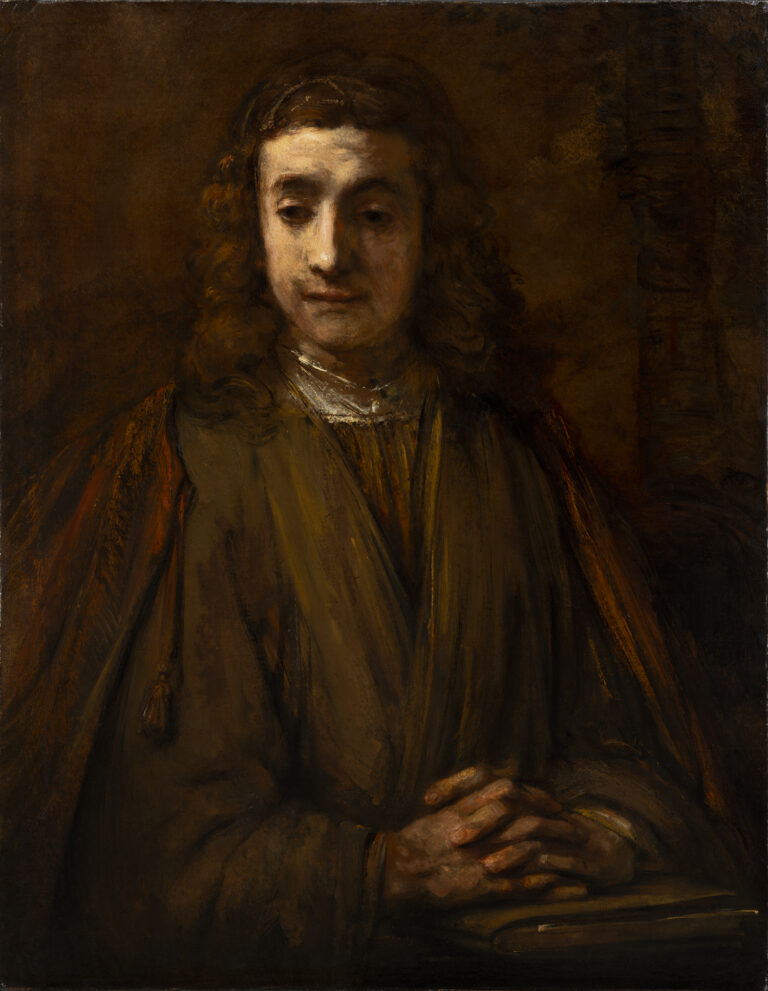
Rembrandt van Rijn’s Saint John on Patmos portrays the evangelist reflecting on the spiritual visions he received from an angel on the island of Patmos in the Aegean Sea.1 In this moving painting, John gazes calmly into the distance, looking inward as much as outward, his mind seemingly filled with revelations but at peace. With slightly lowered eyes, he rests his interlaced hands on a leatherbound manuscript containing letters in which he describes these prophesies—texts he would later compile when writing what would become the last book in the New Testament. In the book of Revelation, John explains that an angel of God showed him these visions when he was “in the Spirit on the Lord’s day” during his exile on Patmos for preaching “the word of God and the testimony of Jesus.”2 According to John, the angel, speaking in “a loud voice like a trumpet,” commanded him to “write what you see in a book” and distribute it to seven churches in Asia, including Ephesus in the eastern part of present-day Türkiye (Rev. 1:1–12, RSV). True to this charge, the evangelist’s letters vividly describe the apocalyptic visions shared with him.
Rembrandt identified the young, contemplative sitter as Saint John through his attribute, the eagle, whose head appears in profile looking toward the evangelist’s left arm (fig 1). (This and other details are best seen by exploring the high-resolution image of the painting in the Leiden Viewer, which uses IIIF technology.) The eagle, one of the four protectors of the throne of heaven that John witnessed in his visions, symbolizes his divine revelations. Behind John’s left arm in this largely monochromatic, freely brushed composition, are suggestions of a distant, hilly landscape and a large palm tree that identify the setting as the Greek isle of Patmos.3
The painting’s restrained reddish-brown palette, which has probably become more monochromatic over time, enhances the sense of John’s spiritual nature.4 He wears a loose-fitting brown robe, characteristic of a scholar, over a white shirt, with an open reddish cloak covering his shoulders. Long, wavy brown hair, with auburn highlights, frames his face, which is lit from the upper left. Boldly layered strokes of varied flesh tones model his sunlit forehead, nose, cheekbones, mouth, and chin. Rembrandt evoked the evangelist’s inner life through the vigorous rhythm of his brushwork on the saint’s forehead, applying these impastos in swirling patterns, as though to capture the flurry of visions racing through John’s mind. Rather than precisely rendering the saint’s visage, Rembrandt was more interested in capturing the effects of light. Hence, his brushstrokes do not always conform to the contours of John’s facial features. He left the quartz ground visible in many areas, particularly around the eyes, on the bridge of the nose, and to the left of and beneath the mouth. These darker, brownish-gray areas help shape the face while also expanding the range of flesh tones.
Rembrandt painted John’s hands in a somewhat different manner than the face. On the backs of the hands and fingers, he used light accents on the planes of orange, ocher, and purple more structurally. By contrast, the highlights and thinly painted areas of the white blouse barely suggest form. Instead, these white accents draw the viewer’s eye toward the painting’s essential core: Saint John’s spiritual gaze. Rembrandt’s subtle arrangement of John’s quiet and pensive pose also enhances the sense of the evangelist’s response to his encounter with the angel. His body is turned slightly to the right, but his head faces to the left, toward the light, the source of his visionary experiences.
The earliest known reference to Saint John on Patmos occurred in 1760, when it appeared in the posthumous sale of the collection of Gerard Hoet II (1698–1760). The sales catalogue describes the painting as a beautiful Rembrandt portrait of a young man resting his hands on a closed book.5 The celebrated Leipzig collector Gottfried Winckler II (1731–95) subsequently acquired the painting. Winckler’s 1768 collection catalogue notes the young man’s long, wavy hair and his finely modeled hands, which are described as being in a position of prayer.6 The entry also describes the painting as “rounded on top,” information not recorded in the Hoet sales catalogue. Nevertheless, the painting’s dimensions listed in the Hoet and Winckler catalogue are comparable (approximately 95 x 76 cm), suggesting that the painting may have had a rounded top when it was in Hoet’s collection as well. Its current dimensions are roughly 81 x 63 cm.7
A watercolor by Christian Friedrich Wiegand (1752–1832) provides a sense of the painting’s appearance in Winckler’s collection around 1800 (fig 2). Weigand’s watercolor, which depicts one of the walls in Winckler’s gallery, shows the painting’s rounded upper edge and reveals that Rembrandt’s composition has been subsequently reduced on all sides. The most extreme loss occurred at the top with the elimination of the arched format: John’s head is now much closer to the upper edge of the composition than previously. The significant cropping along the painting’s left edge not only shifted the position of the evangelist in the picture plane but also diminished the pictorial impact of the distant, broadly brushed monochromatic landscape where John had his spiritual encounter with the angel (fig 3).
Whether Rembrandt initially composed this work with an arched top is unknown, but it is unlikely. As argued below, the original composition was probably larger than when it was in the Hoet and Winckler collections. Whatever the extent of the reductions at the top, Rembrandt did not use an arched format at this period of his career. Several of the artist’s paintings from the 1650s and 1660s have been comparably altered, including Titus, the Artist’s Son in the Baltimore Museum of Art (which was subsequently remade into a rectangle) (fig 4) and Bust of a Young Bearded Man in The Leiden Collection (fig 5). In each of these works, as with Saint John on Patmos, the transformation from a rectangular format to one with an arched top gave precedence to the figure while reducing the undefined background areas on either side of the head.
A series of early twentieth-century sales catalogues provides fascinating evidence about further changes in the painting’s appearance, and even its attribution, after Winckler’s death in 1795. His three sons, who inherited the collection, soon dispersed their father’s paintings to several European dealers. The Rembrandt painting of the “praying” man apparently went to an English dealer or collector, who had the work extensively restored. Perhaps because of this restoration, the painting was later attributed to Carel Fabritius (1622–1654), the name under which it appeared in the collection of the American art dealer Theron J. Blakeslee (1853–1914). In his 1904 sales catalogue, Blakeslee indicates that his so-called Fabritius painting, now titled The Advocate, came from the collection of Humphry Ward (1845–1926), a writer, journalist, and art critic for the London Times.8 Significantly, Blakeslee describes the background as a “simple mellow tone of dark green,” a clear indication that nineteenth-century overpaint covered substantial portions of the painting.9
George G. Benjamin, president of the American Art Annual, New York, acquired the “Fabritius” painting for the modest price of $160 in 1904. Less than a decade later, on 18 March 1913, Benjamin sold it at the Plaza Hotel in New York, where the German art historian Wilhelm Reinhold Valentiner (1880–1958) recognized it as a work by Rembrandt and acquired it for $525.
Valentiner was a central figure in the history of the early twentieth-century appreciation of Rembrandt in the United States.10 Before moving to New York in 1908, he had completed his doctoral thesis on Rembrandt at the University of Heidelberg and written a catalogue raisonné of the artist’s paintings.11 His interests, however, extended beyond Dutch paintings, and he actually came to America because of his expertise in sculpture and decorative arts. Wilhelm von Bode (1845–1929), Valentiner’s mentor at the Kaiser Friedrich Museum in Berlin, recommended him to J.P. Morgan, then–president of the Metropolitan Museum of Art in New York, for the position of curator of decorative arts and Renaissance sculpture. Despite this official position, he remained active in the field of Dutch art. By 1913, when he first saw the “Fabritius” painting at the Benjamin sale, Valentiner had already organized the enormous Hudson-Fulton exhibition at the Metropolitan Museum of Art, which included thirty-six Rembrandt paintings.12
Valentiner’s commentary on the acquisition of the “Fabritius” painting provides important information about its dimensions and appearance, but it also reveals much about the New York art market in 1913.13 Although the painting’s shape and dimensions were comparable to those we see today, Valentiner realized that it had been largely overpainted in what he described as “the sweet manner” of English painter Sir Joshua Reynolds (1723–92)—likely by a member of Reynolds’s school. He was particularly critical of the thin, cracked overpaint on the “artificially smoothed face.”14 Valentiner was able to buy the painting for himself quite cheaply because no one else recognized that beneath the overpaint was an original Rembrandt, which he dated to the late 1650s. He speculated that the overpainting, reductions in size, and reframing had all been done in England after the dispersal of the Winckler collection. Valentiner also identified the sitter as Rembrandt’s son, Titus van Rijn (1641–68), basing this identification on facial similarities with Rembrandt’s portrayals of Titus in the Wallace Collection and the Dulwich Picture Gallery, both in London.15
Soon after Valentiner acquired the painting at the Benjamin sale, the Parisian art dealer Charles Sedelmeyer (1837–1925) gave him the name of a restorer who “took off overpaint in various places.”16 When Valentiner returned to Berlin in 1914, he showed the painting to his mentor, the Rembrandt scholar Willem von Bode, who confirmed the Rembrandt attribution. The painting then went to Bode’s restorer, Alois Hauser (1857–1919), for a complete restoration. In 1916, Valentiner, through the intervention of Bode and the assistance of a German art dealer, sold the painting to an important collector from Mannheim, Karl Lanz (1873–1921).17 Almost immediately, Lanz published a collection catalogue in which he celebrated his acquisition of a painting by Rembrandt. The catalogue identifies the sitter as the artist’s son, Titus.18 After Lanz’s death, Kurt Walter Bachstitz (1882–1949), an art dealer in The Hague, acquired the Rembrandt. In 1923, Bachstitz exhibited the newly authenticated Rembrandt painting at the Mauritshuis in The Hague—the last time it would be seen in public for over a century.
Bachstitz soon sold Rembrandt’s painting of Titus to Friedrich “Fritz” Thyssen (1873–1951), heir to the large and important Thyssen mining and steelmaking company.19 By 1926, Thyssen, a German nationalist, had become an active and highly influential supporter of Adolf Hitler, whose career, and the Nazi cause, he helped advance throughout most of the 1930s. After 1935, however, Thyssen, a devout Catholic, increasingly fell out with the Nazi Party—first because he objected to its persecution of German Christians, and then in protest of the anti-Jewish pogroms of Kristallnacht (“Night of Broken Glass”) in November 1938, which prompted his resignation from the Prussian Council of State. After Germany’s invasion of Poland in 1939, he definitively broke with Hitler in opposition to the war and fled to Switzerland. On 11 December 1939, Thyssen was expelled from the Nazi Party and the Reichstag, and his company was nationalized. In February 1940, his German citizenship was revoked. After the Nazis confiscated Thyssen’s art collection, it was stored in Bonn and at the Museum Folkwang in Essen.20
While attempting to flee to Argentina via France, Thyssen was arrested by the French secret police and handed over to the German Gestapo. He was imprisoned in different concentration camps until his liberation by the Allies in May 1945. After being fined as a Nazi supporter at the conclusion of his Denazification Tribunal in 1948, Thyssen and his wife, Amélie, emigrated to Buenos Aires in 1950. His art collection, including this work by Rembrandt, was restituted and sent to him in Argentina shortly before his death. Saint John on Patmos remained with Thyssen’s descendants there until 2024, when an intermediary asked Sotheby’s to auction it in London.
When The Leiden Collection acquired this painting at auction the following December, its subject was, for the first time, properly identified as Saint John on Patmos. This identification was made possible by exhaustive technical examinations and careful conservation treatment undertaken prior to the Sotheby’s auction in December 2025, which revealed the presence of the palm tree and eagle in the painting’s background.21 These motifs signified that the painting portrayed one of Rembrandt’s apostles and evangelists, rather than simply serving as a portrait of Titus as Valentiner and Bode had believed. The closest comparison for Titus’s appearance in Saint John on Patmos is Rembrandt’s near-contemporaneous portrait of his son in the Louvre, Paris (fig 6). In that work, Titus has a similarly long face, pronounced nose, distinctively arched eyebrows, and long, wavy, ginger hair. Significantly, however, Rembrandt modeled Titus’s features more carefully in the Louvre portrait than he did in Saint John on Patmos, where he created a more generalized image, as appropriate for a portrait historié.
Titus, the only child of Rembrandt and his wife Saskia to survive infancy, was born in 1641, one year before Saskia’s death. Her passing devastated Rembrandt. The depth of his affection for his sole surviving child is evident in the many drawings, prints, and paintings he made of Titus, from his son’s infancy to 1668, the year of Titus’s death. Rembrandt’s heartwarming Virgin and Child of 1641 (fig 7), an etching produced in the year Titus was born and a subject unique in his oeuvre, shows the enormous joy he felt with the birth of this healthy child, almost as though it were a gift of God.22 Shortly thereafter, the artist made a tender chalk drawing of Titus asleep in his cradle (fig 8). Rembrandt later adapted the motif in another religious image, his evocative painting of the Holy Family, dated 1645 (fig 9).
In 1649, life became more complicated for Rembrandt after he entered into a relationship with Hendrickje Stoffels (1626–63), which resulted in an acrimonious dismissal of Titus’s nurse, Geertje Dirckx (1610–56).23 Hendrickje seems to have been a warm and caring companion for Rembrandt, but the early 1650s were fraught with personal turmoil for both her and the artist. Saskia’s will stipulated that Rembrandt was bound to transfer half of his and Saskia’s joint assets to Titus should he ever remarry. Largely because he did not have adequate funds to fulfill the terms of the will, Rembrandt and Hendrickje never married.24 When Hendrickje became pregnant in 1654, their unmarried status subjected her to great public humiliation.25 The couple’s daughter, Cornelia (1654–84), was baptized on October 30, 1654.
By the mid- to late 1650s, now a young adult, Titus became more involved in his father’s artistic and commercial endeavors. Titus was active in Rembrandt’s workshop, where he learned to draw and paint as well as to model.26 Rembrandt made several engaging paintings of his son studying and reading, images that capture Titus’s thoughtful personality and continued importance in the master’s life. As Jan Kelch has argued, Rembrandt’s painting Titus at His Desk (fig 10) portrays his son as a melancholy thinker, thoughtfully contemplating artistic creation.27 Titus in a Monk’s Habit of 1660 similarly reflects the spiritual dimension Rembrandt seems to have associated with his son from the time of Titus’s birth. The painting depicts Titus as a quietly reflecting Capuchin monk with downcast eyes, placed within a freely brushed landscape, akin in mood and reddish-brown tonality to Saint John on Patmos (fig 11). As in Saint John, and as appropriate for a portrait historié, Rembrandt somewhat generalized Titus’s features through carefully modulated diagonal brushstrokes.
Titus also appears in a religious context in a freely brushed tronie (fig 12) that Rembrandt made as a study for his magnificent Saint Matthew and the Angel, now in the Louvre (fig 13). In that painting, Titus, in the guise of the angel, gently places his hand on Matthew’s shoulder as he whispers the words of the Gospel into the apostle’s ear. Matthew, his sinewy left hand gently fingering his full beard and his right hand poised to write, gazes into the distance as he tries to comprehend the angel’s spiritual message and transcribe it onto the pages of the open manuscript before him.
In the mid-1650s, the personal relationship between Rembrandt and Titus evolved into one with complicated financial arrangements, reflecting the challenges Rembrandt faced in these years. In 1656, largely because he had lost favor with many of his patrons, Rembrandt declared bankruptcy, which led to the auctioning of his estate, including his large art collection.28 After the family home was sold in 1658, the family moved to an artist’s quarter in the Jordaan district of Amsterdam, eventually renting a relatively small house on the Rozengracht where Rembrandt lived for the rest of his life. During these upheavals, Hendrickje and Titus formed a business partnership, which became official in 1660, to protect Rembrandt from creditors’ further demands.29 With this agreement, Titus and Hendrickje owned all the family possessions—including new paintings that Rembrandt made or money he later earned—so that these assets could go to their heirs, including Cornelia.
The discovery in 2025 of the eagle and palm tree in Saint John on Patmos places this stunning image of Titus within an engaging series of half-length portrayals of religious figures—mostly apostles and evangelists—that Rembrandt executed in the late 1650s and early 1660s. The idea that Rembrandt, amid this season of financial turmoil and domestic disruption, created a loosely conceived and unfinished series of apostles and evangelists, also including images of Christ and the Virgin Mary, was first proposed around 1920 and has been debated ever since.30 The number and character of the “religious portraits” associated with this group has varied over the years, partly because of attribution issues, but the series generally consists of a core of about seven paintings from the early 1660s.31
Rembrandt’s depictions of apostles and evangelists from this period demonstrate a consistency of approach that supports the notion that he conceived these paintings, including Saint John on Patmos, in relation to one another. Before the dimensions of Saint John on Patmos were reduced in the eighteenth century, its size would have been comparable to several of Rembrandt’s related portrayals of New Testament figures—among them, Saint Matthew and the Angel (fig 13) and The Apostle Simon (fig 14), both dated 1661.32 Rembrandt executed these religious portraits with similar color tonalities, largely browns and ochers with occasional touches of red, and with his subjects’ faces illuminated by an unseen light source, while often relegating their hands to semidarkness. Importantly, in this purported series, Rembrandt depicted the apostles and evangelists, and even Christ and the Virgin Mary, as real people who would have walked the earth with passions and beliefs, fears and anxieties similar to those felt by the rest of humanity.
Rembrandt’s deeply brooding portraits of apostles and evangelists, dark in tonality yet luminous in color, convey both the determined faith and the uncertainties and doubts of these humble individuals. As these figures try to comprehend the mysteries of the Christian message, most evidently in Saint Matthew and the Angel, but also in The Apostle Simon, they seem to struggle with an awareness of their own mortality as well. Simon, for example, looks quietly downward, his mind preoccupied with his thoughts, while resting his large, strong hand on a saw, the symbol of his martyrdom.
The mood and character of Saint John on Patmos sets it apart from these paintings, raising questions about the work’s relationship to Rembrandt’s other religious portraits from the early 1660s. Although Roman authorities had exiled John to Patmos, he, unlike Simon, did not die a martyr. At the core of this painting is not the evangelist’s inner struggle but his profound faith. Saint John on Patmos also differs from Saint Matthew and the Angel. Contrary to the heavyset and aged Matthew, who, pen in hand, requires the angel’s guidance to write his gospel, Rembrandt showed John as a young visionary able to contemplate the complex revelations shown to him. John’s demeanor imparts a sense of timeless wisdom that speaks to how these visions captured the spiritual essence of the Christian story.
Before his exile on Patmos, John, the son of Zebedee and Salome, and brother of the apostle James the Major, was a participant in many crucial moments in the life of Jesus Christ. Along with his brother James and Peter, he was one of the three apostles who accompanied Jesus to the Garden of Gethsemane. At the Last Supper, John sat next to Jesus and lay in his lap during the meal. He was also the only apostle who did not forsake Christ in the hour of his Passion. On Golgotha, Jesus specifically charged John with caring for his mother. After the Virgin Mary’s death and assumption, John preached the Christian message in Ephesus until, during the reign of the emperor Domitian (81–96 CE), he was banished to Patmos. Later, under emperor Nerva (96–98 CE), John returned to Ephesus, where he purportedly wrote the Gospel of John, as well as the first, second, and third Epistles of John.33
Rembrandt’s decision to ask Titus to model for Saint John on Patmos suggests that he felt an underlying connection between his own affection for his son and the evangelist’s place in the Christian story. In the Gospel of John, the evangelist is repeatedly described as “the disciple whom Jesus loved,” an intimate relationship that paralleled the loving bond between Titus and Rembrandt. John was also traditionally depicted as a young, beautiful man with long, curly hair, a physical attribute of Titus that Rembrandt emphasized in Saint John on Patmos.
Among Rembrandt’s religious portraits from the early 1660s, the work most comparable to Saint John on Patmos is The Virgin of Sorrows, signed and dated 1661 (fig 15).34 Compositionally, thematically, and spiritually these two compelling works belong together as a subset within this series. In each, Rembrandt focused his image on a frontal, half-length figure situated in a dark, undefined space. These two works convey different, but related, emotional and spiritual responses to Christ’s death by those who knew him best: his mother and his beloved apostle, John. In Saint John on Patmos, Rembrandt focused on the apostle’s revelations about the Christian message. In The Virgin of Sorrows, he emphasized the depth of Mary’s bereavement—not only for herself but for humanity. Indeed, The Virgin of Sorrows represented a particularly meaningful subject for Rembrandt, since he shared her experience of profound grief and loss.35 Finally, in both paintings, but to an even greater extent in The Virgin of Sorrows than in Saint John on Patmos, Rembrandt used broad brushstrokes and highlights for expressive rather than descriptive purposes, applying thickly painted flesh tones over the dark ground.
Although Saint John on Patmos is neither signed nor dated, Rembrandt likely executed it in 1661, the same year he painted The Virgin of Sorrows. It also seems probable that its original dimensions were comparable to those of The Virgin of Sorrows, which measures 107 x 81 cm.36 A comparison of the two paintings reveals the importance of the dark, undefined spaces surrounding the Virgin in evoking the painting’s spiritual and emotional character—an effect that has been minimized in Saint John on Patmos because of the reductions in its vertical and horizontal dimensions noted above.
The close association between Saint John on Patmos and The Virgin of Sorrows becomes even stronger when one realizes that the models for these two religious portraits are Titus and Hendrickje Stoffels—the two people closest to Rembrandt in this period.37 During his difficult years of the late 1650s and early 1660s, they were the ones who cared for him and sought, not only through their love and devotion but also through legal means, to preserve his artistic legacy. Similarly, these two remarkable paintings convey the powerful impact of Christ’s death on those dearest to him: his mother and his beloved apostle. In The Virgin of Sorrows, Rembrandt shows the depth of Mary’s anguish, a feeling that Hendrickje, too, had experienced. In Saint John on Patmos, he conveys the apostle’s understanding of the lasting Christian message revealed through Christ’s life, death, and resurrection. Both subjects were particularly meaningful to Rembrandt. While Hendrickje personified suffering in the face of loss in The Virgin of Sorrows, Titus’s thoughtful serenity in Saint John on Patmos offered a vision of consolation and possibilities.