
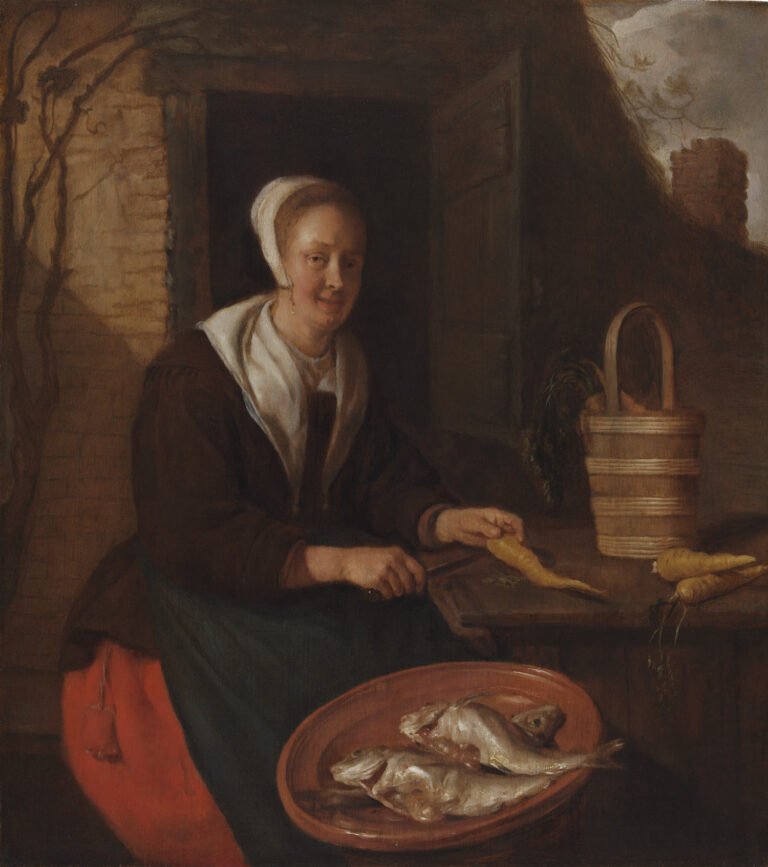
In Woman with Carrots and Haddock, Gabriel Metsu (1629–67) depicts a young woman seated at a table, peeling a carrot. Two more carrots lie on the table, with others in a nearby bucket. Prominently positioned in the foreground is an earthenware plate, tilted slightly to display a pile of fish with glistening scales and exposed guts. With her direct gaze, the woman draws the viewer into a scene of everyday life, with everyday food.
Woman with Carrots and Haddock is one of four paintings from the mid-1650s in which Metsu depicted a young woman handling fish or vegetables in front of a brick building.1 The fish depicted in this painting are haddock (Melanogrammus aeglefinus), a marine fish from the cod family (Gadidae).2 Another work from this group in The Leiden Collection, Woman Cleaning Fish, also features haddock (next to plaice, a type of flatfish) (fig 1).3 In that painting, a prominent set of market scales hanging on the wall at right suggests that the figure may be a street vendor.4 Though no commercial exchange is shown, her direct gaze places the viewer in the role of the customer.5 There are no market scales in Woman with Carrots and Haddock, yet the painting’s similarities to Woman Cleaning Fish—including its subject’s position out of doors while looking directly at the viewer, along with the earthenware plate of haddock tipped invitingly forward—suggest that here too Metsu depicts a food vendor.
Metsu’s scenes of market life have precedents in the sixteenth-century paintings of food stalls by Pieter Aertsen (ca. 1508–75) and his nephew Joachim Beuckelaer (1534–ca. 1574). Their works have been understood as references to sexuality and fertility.6 Consequently, depictions of market exchanges and maidservants by Metsu and other seventeenth-century Dutch painters have been interpreted both as straightforward images of daily commerce and as paintings laden with sexual symbolism.7 In Dutch genre painting, the motif of a maid selling or handling fish often had erotic connotations.8 Yet, in Woman with Carrots and Haddock, the subject’s modest attire and demure expression make such a reading unlikely.9
Metsu lived on a dead-end alley off the Prinsengracht in Amsterdam, just steps from the city’s vegetable market.10 As he walked through his neighborhood, he would have passed the large market and encountered many street vendors selling fish, poultry, vegetables, fruits, and pancakes, the very foods that he depicted so compellingly in his paintings.11 The neighborhood was an important social unit in early modern Dutch cities, in which social norms dictated honorable and convivial behavior. While street vending was a common aspect of neighborhood life, it needed to be conducted appropriately, or residents would complain. The seventeenth-century owners of Metsu’s paintings of orderly street markets and prudent food vendors likely viewed them as embodiments of “the social control and moral code inherent in neighborhood networks.”12
Sixteenth-century scenes of market stalls like Aertsen’s and Beuckelaer’s often overflow with poultry, fish, vegetables, and fruit, each rendered with such precision that individual species can be clearly identified. While some seventeenth-century Dutch market scenes still display a variety of foods—for instance the vegetables and poultry in Metsu’s The Vegetable Market in Amsterdam (fig 2) or the range of fish species in Emmanuel de Witte’s The Nieuwe Vismarkt (New Fish Market) in Amsterdam, 1655–92 (Rijksmuseum, Amsterdam)—Dutch genre painting in this period shifted toward more subdued depictions of food handlers, featuring fewer items and little variety. Woman with Carrots and Haddock, for example, features only two types of food. Leiden fijnschilders (fine painters) in particular seem to have produced such modest scenes, for instance Gerrit Dou’s Herring Seller and Boy (fig 3). Likewise, women preparing simple foods also appear in domestic scenes such as Frans van Mieris’s Elderly Couple in an Interior (fig 4), in The Leiden Collection.
The fish and root vegetables in Woman with Carrots and Haddock were staples of the Dutch diet, sold at large markets and by small-scale street vendors alike.13 Haddock and plaice were both commercially exploited species and readily available. The sixteenth-century fisherman and naturalist Adriaen Coenen (1514–87) noted that haddock was caught in abundance along the North Sea coast of the Low Countries, an assertion confirmed by later seventeenth-century sources.14 The exposed fish guts in Metsu’s Woman with Carrots and Haddock and Woman Cleaning Fish likely represent the livers, which were considered a delicacy.15
The accurate rendering of plant and animal species reflected a broad interest in the natural world’s diversity. For instance, collectors in the seventeenth century prized print series with anatomically correct images of flora and fauna. Perhaps the first of such series specifically devoted to aquatic animals was Nicolaes de Bruyn’s Libellus varia genera piscium complectens, published in Antwerp around 1594.16 Plate 6 (out of 13) shows a haddock, listed under the then-common name Asellus minor (fig 5).17 De Bruyn’s print series was re-published throughout the seventeenth century, for example by De Bruyn’s son-in-law. Other visual material, as well as descriptions of paintings in inventories, confirm that haddock was frequently depicted in the Low Countries.18 Dutch painters were also invested in rendering the surface textures of fish.19 Capturing the sheen of fish scales, for example, allowed painters to showcase their capacity for mimetic representation. This attention to texture was probably a key factor in the appeal of the many Dutch Stillevens met vis (fish paintings), which ranged from genre pieces and market scenes to still lifes.
This fascination with materiality, or outward appearance and surface texture, also intersected with the broader Dutch collecting culture: preserved aquatic animals, including fish, were included collectors’ cabinets.20 Rembrandt’s, for example, contained both sea and land animals.21 In early modern collections, the surface textures of preserved animals could determine how such naturalia were ordered and classified.22 Collectors and naturalists experimented with various preservation techniques, such as drying or storing in alcohol, to retain the specimen’s defining surface features. This task proved particularly difficult in the case of fish. Images of fish, which were often included in the same collections, offered a clear advantage over preserved fish: they provided a stable, lasting representation of the scales’ color and sheen.23
Painters from Metsu’s native Leiden, such as Gerrit Dou (1613–75) and Frans van Mieris (1635–81), specialized in genre paintings of women selling or handling food, including fish (as in fig 3).24 Paintings by Dou, in particular, were highly appreciated for their fine and delicate brushwork and could be extremely valuable: a painting described as “een vrouken met pekelharinck” (a woman with a salted herring) was appraised at 1,000 gulden in a 1691 Antwerp inventory.25
Metsu adopted the subject matter of these artists after his move from Leiden to Amsterdam in the mid-1650s, but he did not adopt the delicate and time-consuming painting style of these Leiden “fine painters.”26 Rather, he found his own distinct success in the Amsterdam art market through his free brushwork, capturing fresh fish with their glistening scales and depicting women with an empathy and human quality that still captivates us today.